Wednesday, July 11, 2012

Snow White

Or, the Raid on Luang Namtha

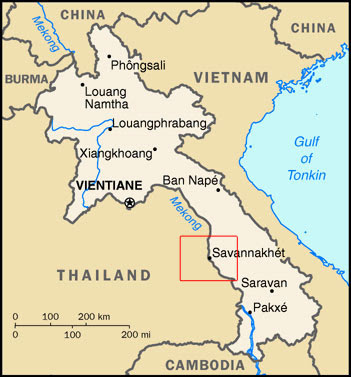
Since I haven't been chronological in this blog, there is  no reason to begin now.  The Raid on Luang Namtha was not a raid on that particular hamlet, but very near to it.  It was midway in my time in Laos and fortunately for me, not my first operation in country or this would have probably freaked me out. I have not to this day been real sure of who was involved.  I knew most of the CIA personnel in Laos. James Bradley was the person I reported to when in Vientiane.  Tony Poe was the operator in Long Trieng and worked with Gen.Vang Pao, but I think Jerry Daniels was the station chief there..  Richard Holm was, I think , at Ba Na west of Long Trieng and I heard that he ended up at Savannakhet.  I don't know who the CIA honcho was at Savannakhet if it wasn't him.  Bradley was in charge of this particular mission.  Now I knew him as Colonel Bradley, but I don't think he was a colonel.  I don't think he was military although he could have been one in the past.   He rarely acted like he was in the military and I never saw him in uniform but twice and it didn't fit him very well in either case. The actual cast of characters who were involved is still a mystery to me.  I know that some PARU were involved because they were with me. There certainly were some CIA operators.  I believe that the B-26's used in this operation were out of Tahkli and Udorn, but since they carried no markings, I have no way of knowing for sure.  The T-28's could have been out of Vientiane or Long Trieng, but I don't think so because I didn't recognize the voices of the flight leader.   Where the C-123 came from that carried us up north, I can only guess.  The helicopters used were of unknown origin as well.  They would be Bell 204's. They had no markings of any government or Air America.  I suspect that they used the Bells because they were faster and could lift heavier loads at higher altitudes than the H-34's that were also available.  I can only suppose they belonged to the CIA.  I have no idea as to where they came from or where they went after the mission was completed.  The mission was called "Snow White".

Bell 204B Helicopter from Air America's Fleet


I originally was told this was an operation to capture gun runners out of China and/or Burma bringing arms to the Pathet Lao troops on the Plain of Jars.  I was just naive enough to believe that information at the outset of the operation.  It should have been obvious to me that they didn't need to bring weapons into Laos that way as they had a funnel right down the border of North Vietnam and Laos called the Ho Chi Minh Trail.  However, after the operation got underway, it became obvious  that it was not weapons they were after, it was the white powder, opium, that they had their sights on.  

This operation was to take place south of Luang Namtha, about 25 miles from the China border.  This site was chosen because it would be the least expected place for an ambush being it was that close to China.  There was to be pack train of  up to 50 mules, guarded by some 20 to 30 armed men.  We wouldn't know exactly how many until the operation was underway.  As with other missions I was to handle the air ops in and out of the ambush site.  I was to be sent in with two four man PARU units.   One group would jump with me and they would carry the radios to the operational site.  The second PARU team would jump 10 miles from the site and carry a portable TACAN unit in with them. This was to be used by the aircraft to find the ambush site.  After the air assets crossed the TACAN, then I would take over operational control from that time onward.  The one thing that really bothered me about the TACAN was that it was on one of several known frequencies.....known not only by the friendlies, but also by the enemy.  It was anyone's guess how long it would take Chinese, North Vietnamese, or Russian advisers to pinpoint its location and then try to knock it out.   The plan was to turn it on about one hour before the strike.  The TACAN team would jump first followed a minute or two later by my team and the ambush unit.  We were told to prepare for a three day trip although it probably wouldn't take but two days.

 At the pre-ops briefing we were told that we would have two flights, one of two B-26's and one of  four T-28's for the operation.  The B-26's would be used in the initial attack and the T-28's for air cover during extraction.  The second flight could also be used to finish up what the first flight may have failed to accomplish.  The first flight was to use the call sign Tango with the flight leader Tango One.  The second flight would use the call sign Echo with it's flight leader Echo One.  The extraction helicopters would go by the call sign Zulu with Zulu One being the lead helicopter.  The missions call sign was "Snow White" and it was the call sign I would use during the mission.  It was one of  the many code names for opium.  I had heard it called China White before, but in this instance it was "Snow White."  We would ingress via a low level parachute jump out of a C-123,  I would jump with my PARU team and jumping with us would be 15 para-military types who would carry out the actual operation.  When they boarded the aircraft, they were a mixture of Thai mercs and American personnel.

I have no idea as to who the Caucasians  were....maybe SOG guys, maybe CIA.  They were in military uniforms but not American uniforms.  They were heavily armed with AK-47's, sub-machine guns, side arms, grenades, and one BAR.  They looked like they were carrying 60 to 70 pounds of gear each. There were no patches, rank, or anything else that would identify who they were.  From the moment they boarded the aircraft they talked to each other in hushed tones and never said a word to me the whole flight north.  I did figure out they were speaking French which the Thais understood as a second language.

I was told that we would fly the same route that some weapons smugglers used in flying contraband  weapons south, and probably no one would pay much attention to our C-123 flying that route at night. I was sure hoping that was the case.  It actuality, it was the same route the drug smugglers flew, not gun runners.  But it did make sense to me at the time. Making a night jump in Laos, even from 1000 feet AGL (above ground level) was a sticky wicket. You had to depend on the pilots to put you on the DZ.  Miss by a few hundred yards or by a mile and you ended up in the forest canopy.  Not a great option I can certify by personal experience ( I once hung in a tree for three hours because it was dark and I had no idea how far off the ground I was.  It turned out I was about 50 feet off the ground.  A good thing I didn't hit the quick release during the night.  It was also a good thing that there were no Pathet Lao in the area as well.).

(To Be Continued in Next Post.)


Sunday, June 24, 2012

A Thousand Ways to Die

It seems apparent that death comes easy in the "Land of a Million Elephants" and it really does.  It is not just the bullets, hand grenades and booby traps you have to survive, but the the terrain, the weather, the diseases, the flora and fauna, and a whole lot of other things.  One of the very first lessons I learned was that you have to be a lot more vigilant on back trails as they are the ones most often booby trapped.  The main trails the villagers use along with enemy soldiers are watched for the most part, so in almost every case, they are not booby trapped.  Moving down the main trails in daylight is a guarantee for capture or death.  But at night, the villagers and enemy soldiers tend to stay in their compounds and houses or encampments. You can move, if you are very careful, down the main trails with some success.  A lot of times the soldiers watching the trails fall asleep or are otherwise occupied.  

Using the back trails is sometimes necessary, but must be done carefully.  Some areas are not booby trapped at all, others are heavily so.  Vigilance is the key here.  Looking for things out of place...things just not right.  Dead falls, punji pits, trip lines, etc., were all menaces of the back trails.  It was not normal for Bailey or myself to endure a lot of this because we usually just did the insertion and extraction duties, not make the humps with SF SOG guys.  Later on, some real hard core combat controllers were embedded with the SOG teams, but not at this particular time.  Now that I have said that, let me clarify a little.  We never knew what the other air force personnel in the panhandle and southern Laos were doing.  Some were with the Butterfly program and others could have done work with the SOG teams along the Ho Chi Minh Trail.  Someone else would have to furnish that information. We only knew about our part of the Laotian War as we only operated in Northern Laos from Vientiane north to Chinese border and east to the North Vietnamese border. 


The flora and fauna could be a menace as well.  There were many kinds of poisonous plants, razor grass, and thorn bushes that would rip the clothes right off of you if you walked just a few hundred yards in them not to mention what they did to you body.  You certainly didn't want to try and run through them. 

Snakes were another problem altogether.  There were a lot of snakes.  This was the land of snakes. Leave them alone and they would probably leave you alone.  There was at least four kinds of Cobras. The Monocled cobra was the most prevalent of the Cobra family.....also the most aggressive.   The King Cobra was a big poisonous snake.  However, left alone it was pretty docile.  I saw several of these while in Laos.  For me the Russell's Viper was as dangerous a snake as there was.  It is almost invisible in the jungle, it packs a lot of venom and it tends to be aggressive.  More people die from Russell's Viper bites than from any other poisonous snake  in S.E. Asia.  There was a statistic provided by the Australian embassy that 37 out of every 100 poisonous snake bites ended up in death.  With Russell's Vipers, it was much higher.  The reason that 63 people did not die from poisonous snake bites is they probably did not get envenomed by the bite.  A great many times people were bitten but it was a defensive strike and the snake did not inject venom.  But if you sustained a real bite, there was not much help if you were out in the boonies.  The only real infirmary was in the Australian Embassy in Vientiane.  If you were close enough to aircraft, you might be flown to somewhere in Europe or Japan where you could receive treatment, but even then you had to be awfully lucky to survive.  The other dangerous snake (just because it likes to live near humans) is the Common Krait shown in the left picture.  The Russell's viper is on the right.  The Kraits venom is ten times more powerful than a King Cobra.

.

Then there were the insects.  Scorpions as big as your hand (not deadly but very painful) and foot long centipedes head the list.  I have been stung by both and neither is a pleasant experience.  There were other biting bugs and stinging ants in plentiful supply.  But the one insect that would drive you nuts was the mosquitoes.  They could, at times, descend on you like a moving cloud.  Sometimes you could use a repellent supplied by the military, but out in the bush, the enemy could smell it a mile away so you didn't use it very often if at all.  

Next for me as a miserable creature were the leeches.  They were everywhere during the rainy season.  I was familiar with leeches because I had dealt with them when I was a kid.  We had a creek we swam in that at times had leeches in it.  My grandmother would put salt on them and they would then fall off.  In Laos, it was almost impossible not to have them attach themselves to you.  And once you removed them, or they got the meal they wanted and fell off, you bled like a stuck pig for hours.  Not dangerous but a nuisance of an unbelievable nature and you looked just like you felt, a bloody mess.

Then there were tigers, elephants, leopards, black bears, and a host of other mammals to contend with in the jungles and mountains of Laos.  I saw several tigers while in N.E. Laos and had personal encounters with two.   I heard a lot more of them at night in the mountains as they roared looking for a mate or after a kill.     I also did see some that hunters had killed for the skins and internal organs which had some perceived medicinal value to the Chinese.  Never saw a bear in the wild, but did see two leopards.  However, some villagers used elephants and did see a few of them, never in the wild however.  Someone asked about crocodiles.  I don't think that there was any large crocodiles left in northern Laos by the time I got there.  I saw some three to six footers, but never a big one.  There could have been some further south, but never saw a large on up north.  They were pretty well hunted out in the 1950's. 

Then there were the inevitable aircraft crashes.  Whether from mechanical trouble or from ground fire, many Laotian and Air America aircraft and helicopters made hard landings.  Sometimes the aircrews walked away from the crashes, sometimes they didn't.  The UH-34 helicopter was made in part from magnesium which when set on fire went up like a giant sparkler.  If it got hit just right, even if you managed to get it on the ground, you could still be burned alive from the fire before you could get out.  SAR (Search and Rescue) missions were run by Air America when it came to Laotian and Air America aircraft downings.  At some point MACV and the USAF ran SAR for USAF aircraft, but at times the only SAR available were the Air America aircrews.  One of the times that the helicopter I was riding in went down was when we were on an SAR mission looking for a downed C-123 out of Savannakhet in the panhandle of Laos which caused an SAR mission to retrieve us.  There was a lot of ground fire going on but we never saw or heard anything that would indicate we had been hit, but that's sometimes the case.


Anyway, this is just a few of the many ways to die in Laos. 


Tuesday, June 19, 2012

Part III - The Poppy Wars or, to the ones involved, 

"Poppy Ops"

One of the most eye opening things that happened in Laos was what was known as the Poppy Wars, or as Bailey and I observed, "Poppy Ops."  For all the denials of drugs for weapons that went on in the Reagan Administration during Iran/Contra investigations, it was nothing in comparison to what went on in Laos.  There was a literal war going on between Gen Vang Pao and at least two drug lords in China and Burma.  I am not sure of their names although I heard them named several times.  Up to 400 tons of opium was being moved out of Burma and through Laos into Thailand each year. I had heard that the amount was 40 tons from 1958 until 1961 when apparently the flood gates opened up for trafficking down into Thailand.  I remember the CIA in the late 1960's denying that they were involved, but involved they were....right up to their eyeballs.  In the motion picture "Air America" the pilots were depicted as moving dope for guns and such.  Although I am sure that some of that went on, most of the Air America pilots never really knew what they were flying from one place to another except for what was marked on the bags and crates.  They may have some inkling that it was drugs, but it wasn't openly discussed even if they knew.  There were other more secure ways of moving drugs in Laos than using Air America to do the job.

On almost any visit to Vientiane you could spot the drug runners by how they dressed and the weapons they carried.  The French Secret Service was involved along with Vang Pao and two other notable Laotian generals.  And for the record, the North Vietnamese were involved as well.  The North Vietnamese wanted control of the drug trade just as much as the Laotian generals did.  After the Geneva accords were signed, all foreign military personnel except for embassy guards were supposed to leave the country.  Never happened.  Some left of course, but many remained and just changed into civilian clothing and denied they were military personnel.  The French Secret Service had people there along with the Australians  There were Russians and Chinese and Vietnamese there as well.  The U.S. Military was present represented by non-uniformed servicemen including Army Special Forces guys, U.S.A.F. personnel including yours truly (all in civilian attire), ex-military types that had resigned their commissions or left the service and were working for the CIA, and all sorts of undercover foreign military types.  In the end, no one was fooling anyone.  The place was teeming with military personnel of many nations all wanting control of Laos and its busy drug trade.

For people like me, it was a strange environment.  I don't think I ever thought about illegal drugs even when I was in high school.  I never knew anyone who took them and about the heaviest thing I ever did was a couple of beers.  None of my friends did drugs and I just didn't see drugs in the 1950's.  I am sure they probably were in our high school and other places, but I just never saw it.  In Laos lots of people did drugs.  Many people smoked opium.  Others turned opium into #2 or #4 heroin and used it or sold it. Others even took the refinement further and turned it into morphine.  But for the most part, it was opium that moved through Laos and the refinement was done elsewhere in Thailand or some other part of the world.  However, General Vang Pao did his refinement of opium into heroin right in Vientiane and he didn't spend a lot of time trying to conceal it from anyone..

Who was really in charge of all of the opium movement in Laos remains unknown to me.  It was apparent that the CIA was heavily involved and knew exactly what was going on.  Just how much MACV knew, I cannot say.  But I know this, the "Poppy Ops" involved the U.S. Military because in involved Baily and myself and apparently several  SF MACVSOG teams.  Again, without anyone wearing uniforms, it would be impossible to know for sure who was involved.  Certainly former French Foreign Legionnaires were operating for the drug cartels in country.

The flow of drugs from far northern Laos and Burma went in two directions.  On path south of the China - Laos border back into China.  The southern path took it through the Laotian mountain ranges  south to the Mekong River and depending on the season, either down the river by boat, or, in the dry season, down one of three trails that followed the river south.  All the routes except the China route were susceptible to raids by bandits, the CIA, contending drug cartels, or the Laotian generals.  I can't prove it, but I don't think any of the drug raids were initiated by the U.S. Military.  U.S. troops were involved, but how they were involved still is in question even to this day.  Although I primarily worked with Bill Lair's PARU mercenaries, I also worked with the SF SOG guys as well.  In a future chapter on this blog I will detail one of the missions to intercept a drug shipment coming out of Burma.  This was, without doubt, a CIA hit on a shipment made by a noted drug lord in Burma. This I know, Laos was the wild west of the heroin and opium world in Southeast Asia.  One of the drug lords of the north was Khun Sa.  He was located in the Shan State in Burma.  Another was Gen Ne Win who headed the Burmese Governments Army.

                                                                                                                 Khun Sa of the Shan State

To show you how valuable and important was the drug trade, I will give you a few 1963 statistics as made known to me by people in the know.  The typical poppy grower in N. Laos or Burma made an average of 100,000 Kip Laotian for growing poppies.  That relates to about $200.00 per grower per year.  Turned into 5 lbs of raw opium it was worth $1,000 to $4,000.   That 5 lbs of opium turned into #2 morphine base heroin was then worth $8000 to $10,000 on the wholesale market and much more when sold on the street. It still had to be refined down to #4 grade heroin.  Once that was done, it was worth upwards of $250,000.  And of course, it no longer weighs 5 lbs.  No wonder Vientiane was awash in cash.  And no wonder, that the CIA along with countless other entities wanted a piece of the action.

Until next time.

Sunday, June 10, 2012

How I Got To Laos in the First Place

The story behind getting to Laos is not too complicated.  After tech school, I was sent to Sheppard AFB, Wichita Falls, Texas, as a 27230 trainee.  This was in January of 1961.  I got my 5 level sometime in the late spring of that year.  After coming in from a mid-shift at the GCA unit, I was approached by a Captain in the flight facilities building who requested some time to talk to me.  I found out later that he had cleared this with my immediate commanding officer.  He introduced himself and stated that he had been looking at my files and thought he might have a perfect job for me in the air force.  He explained that there was this special unit in the air force called a Combat Control.  He said that there were very few people doing this job and he could guarantee that I would be overseas before long.   He went out of his way to not inform me much about what this was all about but said that there would be a lot specialized training.

He had me fill out some forms and sign them and said he would get back with me later.  I had almost forgot about the thing as a month passed and I had heard nothing about this "combat control" thing.  It is interesting that the term "Combat Control" was never used during any of our training or ever mentioned again.   As I went through flight facilities one morning, I was told I need to talk to my commanding officer.  He told me I had been accepted for a special project and warned me that it was a mistake to volunteer for this unit as it might not be as advertised. He asked me if I wanted to cancel the whole thing.  I was kind of bored at Sheppard as traffic was sparse except during alerts so I decided to go ahead with the training.

About a week later the captain I had originally been contacted by had me meet him in a private room at the flight facilities building where he briefed me on what was coming up.  He told me I needed to get in good physical condition on my own as most of my training would be done on my off days from the radar unit.  He said I need to build up my endurance and told me I need to get a rucksack and put about 25 pounds of rocks in it and start running.  Let me tell you that the first couple of weeks of that like to have did me in.  On my off days I was sent to Webb AFB TDY for special training in the ways of what I believed to be combat control. After two or three days at Webb, I would be flown back to Sheppard to do my regular shift rotation in the radar unit.  This went on for about 8 months.  The interesting thing about Webb AFB is the fact that they had T-28's stationed there.  I worked with pilots flying these aircraft not knowing that my future would be filled with T-28's flying overhead.

 T-28's stationed at Long Tieng (LS20A) Laos 1963,


I was then sent to Ft. Bragg for two intense weeks of jump training with the Special Forces guys who were on their way to Vietnam.  Little did I know this was done for a particular reason.....that being that the people I would work with most in Laos would be SF guys.

Other training continued until I received orders that I was being shipped out to Incirlik AB, Turkey.  I had no idea as to how this related to my new profession, but in world of "Black Ops" you are not supposed to know.    I was assigned to Incirlik tower although I had never had been in a tower since Keesler Tech School.  Again, the posting was designed for a particular reason.  It was far from Laos and it was involved in covert operations.  Stationed at Incirlik in those days were U-2's and several types of ECM aircraft including C-130's and a couple of B-47's. Just east of the tower was the famous "Black Ops" hanger that contained the U-2's and other covert aircraft.  I would pull regular shifts in the tower and then I would be summoned and sent to Laos on a flight that took most of a day to get to Udorn RTAFB in Thailand.  After a while, because of the frequent trips to S.E. Asia, I wasn't even regularly scheduled in the tower any longer.  I would just work for someone who wanted off for the day or night.

Eventually, a RAPCON unit was flown in and installed and I was assigned to it.  However, no other RAPCON or radar qualified controllers were ever sent to Incirlik AB until after I went back to the states.  That meant that I was the only one in the building at any time except for the occasional technician that was flown in when we had equipment trouble.  One of the advantages of not having anyone else assigned to the radar unit was the fact that there were no witnesses.  I could come and go as needed without a lot of questions.

Sometime later, maybe three weeks or so after the RAPCON became operational, the real piece of equipment I was waiting for showed up.  We had used this at Webb during some of my training.  It was a  portable radar unit.  It was small, compact and consisted of three pieces.  The CRT with a hood for use in the daylight,  a small camo radar dome, and a diesel powered power supply with super quiet exhaust system.  It was designed to be packed in or air dropped.  It had a maximum range of 47 miles.  I have tried to find this unit online over the last few years and can find no reference to it at all.  There were just two of these built and I had one at Incirlik.  The plan was that this unit was to be used during the monsoon season in Laos to direct air strikes against the Ho Chi Minh trail, although that was never mentioned to me.

It was highly reliable in perfect conditions.  It never saw perfect conditions.  We actually parachuted it out of a C-130 for test purposes and on landing it knocked every tube in the unit loose and broke at least two of them.  It was determined that the tubes should have been strapped in with small metal straps.  We tried it again and again it failed the test.  After that, it was determined that the only way the unit could survive a trip to a combat zone was that it had to be helicoptered in and moved by man-power to where ever it was needed.  It was a good idea that just didn't pan out like it should have. When the age of transistors and ROM memory modules showed up, I believe a unit could have been produced that would have survived air drop.  Not this one though. 

 However, we did prove the worth of trying it when it was used at Phou Phi Ti in 1963 in support of General Vang Pao's troops where we successfully were able to provide some air support during the daily rain storms.    More about General Vang Pao later.  What actually happened is the portable small  radar unit was phased out as impractical in S.E. Asia and a mobile/portable TACAN unit became the replacement.  It was much more robust and could handle being dropped out of the back of an airplane. It was relatively easy to set up and maintain.  On a mountain top it had pretty good range.

 Laotian General Vang Pao in the
early 1960's.


Once I was assigned to the RAPCON unit, going and coming from Incirlik was a lot easier than when I was in the tower.  I no longer had any responsibility to the tower and therefore really had no one in ATC directly over me at Incirlik after that.

Now, a side note.  I used the term "we" when I talked about what we did at Webb.  The word "we" meant myself and one other controller named James Bailey affectionately  known as "Beatle Bailey" after the comic strip character.  His call sign became "Beetle" in Laos.   He so reminded me of Beatle Bailey that you couldn't help yourself when talking about him or to him.   He was my counterpart.  He went through all the training with me and then was shipped to Okinawa or Japan.   I am not sure which because I never saw him again.  He would be in country when I wasn't or I would be in country when he wasn't.  They only wanted one of us there at a time.  I heard that Bailey died of brain cancer back in the 1980's. As far as I know, Bailey and myself were the only ones to have trained on or used the portable radar unit and the only personnel targeted strictly for Laos.

It wasn't until later that both of us found out several  reasons why we were selected for this duty.  First, we both were ham radio operators.  We could use CW (Morse code) without having to be trained for it.  All HF transmissions to Vientiane were carried out in coded CW.  The main radio in Laos was the AN/GRC 109 CW HF radio which wasn't much different than the old Hallicrafters radios we used in ham radio. We also carried a GRA71 (believe that is the unit) 300 WPM encoder. Being ham radio operators, we also kind of knew how to troubleshoot a radio and do minor repairs.  That was a big deal a couple of times.

We also had used VHF and UHF radios which would be used to contact aircraft and helicopters used in support of the Laotian Army.    No extra training would be required in either case.  The only real thing we needed to know was the protocols.   Secondly, we both were former boy scouts and had done survival training at summer camps. However, we did do survival and jungle training for two weeks in Panama with a SF team which was very interesting

And that is how I ended up  Incirlick AB, Turkey, and northern Laos.

Tuesday, May 29, 2012

 Dark Shadows in the Black Laotian Night


 I need to make a point here before I go on to the writings that follow.  These were events, actions and operations undertaken by the PARU's under my control as an Air Ground Controller or Forward Air Guide, whichever one prefers to use. I will not use actual names or places because a lot of what you are about to read is still classified.  The DOD has slowly released information on Laos over the years, but a lot of it involving the CIA, Air America, MACV and several foreign countries are still being held as classified material to be released in 2035.  I won't be around then, so I thought I would go ahead and tell the stories so that some of what I did in Laos will be told before I die.  I will use the names of people that are known and their activities declassified.  Such people as Bill Lair, Tony Poe, and James Bradley are examples.    I hope what you read here will enlighten you as to some of the things that went on  in the secret war in Laos.  For your information MACV stands for Military Assistance Comand Vietnam.  It replaced the old MAAG, Military Assistance Advisory Group in 1962, just before I got to Laos.  MACVSOG stands for Military Assistance Command Vietnam Studies and Observation Group.  This was the designator for those operating on the ground.   In theory, SOG did not exist until 1964, but none-the-less, they were operational in Vietnam and Laos in 1962.

You will hear me mention Bill Lair's PARU on many occasions. My team was made up of Thai PARU mercenaries.   I called them BL's mercs.  Every PARU was efficient at a particular skill:  heavy weapons, demolition, radio operator, and in hand-to-hand combat.  Most PARU spoke not only Thai, but also one other language, usually Lao or Mhong and/or English.  Some even spoke Vietnamese or Chinese.  Bill Lair had been posted to Thailand in the mid to late 1950's by the CIA and he subscribed to the idea to build an irregular army to fight the communists in S.E. Asia.  Bill Lair established at least two PARU  training bases there and maybe more.  The PARU were some of the best fighters I ever knew.  PARU stands for Police Aeriel Reinforcement Unit.  By the way, they were all jump qualified.  An American front company, Southeast Asia Supply Company, or, as most of us knew it,  Sea Supply, was also created to administer the training programs under Bill Lair.  The layers of cover for the CIA were very deep in those days.  Another group I need to mention are the "Butterflies."  There were six of them that I knew of and I never knew any of their names until later.
These, or at least some of them, were Combat Controllers.  This was a new class of airmen trained for combat situations.  Some of them flew around in O1 Bird-dogs directing airstrikes on enemy positions, primarily in the panhandle and southern parts of Laos along the Ho Chi Minh Trail. known to most in country people as the HCM.  I think they arrived in 1962 with the first contingent of  Air Commandos who were sent to Tahkli and Udorn.  I think, most however, were stationed at Ben Hoa or Ton Son Nhut in South Vietnam.  They were replaced in 1964,  after I left Laos, by Forward Air Controllers or "FAC's". Some FAC personnel later became part of the famous "Ravens" located at the secret base in the mountains 90 miles north of Vientiane, the capital of Laos.  That base was LS20A also known as Long Tieng.

It's 02:30 AM Laos time.  Out of the darkness of the night come five figures who, in the fog, you just make out to be men.  Just seventy-two hours earlier my team inserted a MACVSOG team onto the Ho Chi Minh Trail east of  Phou Phi Thi.  Team Charlie now was ready to be extracted.   There were four Special Forces guys and one man who was obviously oriental  and non-cooperative. They had obviously got what they had gone in to get.  We never knew what the MACVSOG teams were up to and never wanted to know.  Everything in Laos was on a need to know basis and what they were doing, we didn't need to know. Because of where we were, we needed a helicopter pickup.  I sent the following message to Vientiane:  "Xtract. 181X2. 4+1X2 Reply Forcast  Reply zulu.  Reply Navigator."  Then it was time to wait for Vientiane to reply.    It was a two mile hump to the pick up at LS-81 and I told the 1-0 that we would need to get moving as soon as I heard from MACV.   Approximately 30 minutes later we got the message that pickup would be at LS81 at 0600.  I was to expect two UH-34's with two T-28's as escort and for ground support if needed.  By this time is was about 0330 and it would take about two hours to get to LS81.


You could hear the UH-34's as we approached the landing zone. I immediately got on the VHF radio an directed the choppers to our location.  Only one chopper would land at a time so that one was in reserve in case of trouble.  The first one picked up the MACVSOG team and once it cleared the trees, the second set down and retrieved us.  Both helicopters were owned and operated by Air America.  Just like us not knowing what the MACVSOG teams were doing, the Air America pilots  probably had their ideas about what we were doing, but really were not sure.  Again everything in Laos was on a need to know basis, so they supposedly didn't know. We never saw the SF team again as they flew to some predestined location not known to us.  We would return to Long Tieng, north of Vientiane, the capital of Laos.  After landing, I met with a CIA operator who did know what was going on and was debriefed.  My PARU team would return to their training base in Thailand and I would jump into a Helio-Courier and fly to Udorn RTAFB to catch a plane back to Turkey.  Frankly, it had been a rather longer than usual mission because it required that we  stay on the ground and wait for the MACVSOG team to come back for extraction.  We had to find a good hide and stay put.

This mission had been different that previous ones. First, this was a Special Forces team I had not worked with previously. My primary team was Team Falcon.  Secondly, normally we would have inserted the team and then returned to our base and waited to go back in for the extraction.   This time was different.  I don't know why we had to stay on site, but it was a dangerous strategy.  Where we inserted the team was sparsely populated, but everyone there was in league with the Pathet Lao and North Vietnamese. You couldn't be seen by anyone, much less have contact with them.  Other insertion teams had been lost because of discovery and it was an ever present danger. My team had inserted a South Vietnamese Special Forces team a few weeks before that into North Vietnam and they never showed up for extraction.  They were never heard of again.  No one to this day knows what happened to them.

It was a cat and mouse game with the North Vietnamese and Pathet Lao.  They knew we were putting teams on the ground around the Ho Chi Minh Trail and into North Vietnam itself.  Our job was to get the teams on the ground and underway and provide additional firepower for them inc case of an ambush.  We would remain on station until they disappeared into the jungle. I don't know what their job was, but obviously it was important to MACV.  Most of the time it was probably to gather intelligence data or, in the case above, kidnap some NVA officer or official.

Then, it was wait for the extraction of the teams as they returned from their missions.  On two occasions we inserted South Vietnamese SF teams into N. Vietnam.  But, unlike the team mentioned above, I don't know what happened to them because there was no extraction planned for either team.  At best, it was a hairy place to be.  On this particular mission, we were only 30 KM from the North Vietnam border with Laos and about 120 KM from Hanoi.   You could never count on being one hundred percent safe.  The darkness was your friend, the daylight your enemy.

The reason I was taken to Udorn was to return to the world of the military.  Before going into Laos Baily and I were "sheep dipped."  That means that all of our identity was taken from us including our uniforms.  We wore either civilian clothes or some foreign nations uniforms.  We left our dog tags, personal items, military clothing......anything that could identify us as American military personnel.  I often carried Australian or Canadian passports.  I worked under the alias of "Rick Richards."  Kind of poetic I guess.  Depending on which passport I was carrying, I was given love letters from my "sweetie" in either Ontario or Sidney to make it more real.  MACV and the CIA were covering their asses all the time.  If captured (and I wasn't supposed to be....more about that later) I was to claim that I was a national of the country whose passport I carried.  I was to be a tourist or vacationer or big game hunter lost in the wilds of Laos.  Now, about the "not supposed to be captured" part.  I always had the feeling that someone had the job of killing me before I fell into the hands of the enemy.  Never knew it for sure, but just felt that was the case.

We initially carried U.S. military weapons but were told to switch to some foreign weapon of our choice.  A CIA operator gave me a Swedish K 9MM sub-machine gun and ten clips.  It wasn't very accurate, but at close range it was devastating.  It was also easy to disassemble and repair.  One thing about the Swedish K, you could easily be identified as a drug runner because they all carried sub-machine guns and for the most part, drug runners were left alone by all parties involved in Laos.   I also obtained a AK-47 and ammo after being told that it confused the enemy when we were firing weapons that sounded just like theirs.  However, I rarely carried the AK because I just didn't like the rifle.  However, all of my Thai team members carried them.  Their thinking was that you could pick up ammo from dead enemy soldiers and therefore didn't have to carry as much on the mission.  I came across a FN-FLN Belgian battle rifle that I fell in love with.  It used .308 NATO ammo of which there was plenty available.  I managed to obtain it and I will tell that story later.  The FLN was extremely accurate out to 800 yards and I never had it fail me.  It also provided a squad type light machine gun as the FLN had a rate of automatic fire around 700 rounds per minute.  On a three day R&R to Bangkok, I had a Thai gunsmith accurize the FAL.  It then became deadly out to about 100 yards if you could calculate the ballistics in your head.   The only problem was that it weighed in at 9 plus pounds and the ammo was a lot heavier than either the 9MM or AK ammo.  But that is how it was for us in the early 1960's in northern Laos.  That's it for now, more to come later.